Evaporative condensers are specialised heat rejection devices that combine the cooling properties of evaporation with the efficiency of condensation to remove excess heat from a system. Commonly used in refrigeration, air conditioning, and industrial cooling processes, evaporative condensers are particularly effective in systems where the condensation of a refrigerant is required as part of the cooling process.
Here you’ll find answers to common questions about industrial process chillers
A refrigeration system removes heat from a space or process and rejects it elsewhere using a refrigerant cycle (compression, condensation, expansion, evaporation). Compressor, condenser, expansion device, evaporator, refrigerant, and control system
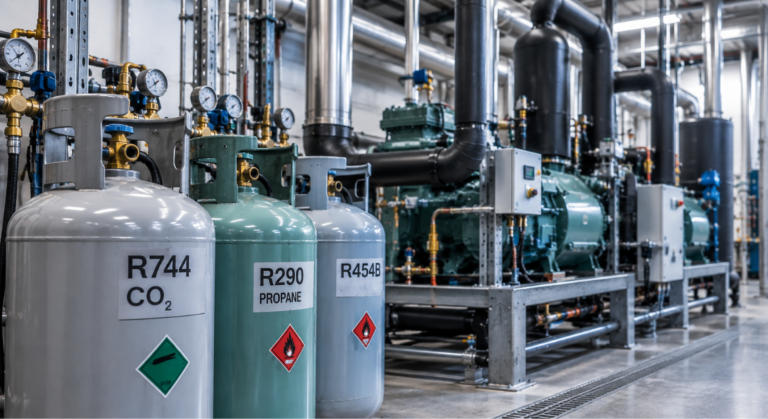
Common refrigerants include R410A, R454, and R32, along with newer low-GWP refrigerants such as R1234ze and R290. Refrigerant selection depends on the application, operating temperatures, system design, and current environmental regulations.
Poor cooling performance can be caused by refrigerant leaks, dirty heat exchangers, faulty expansion valves, compressor issues, or inadequate airflow or water flow. A system assessment is required to identify the root cause and restore reliable operation.
Service intervals typically range from every 6 to 12 months, depending on system usage, operating environment, and criticality. Higher-duty or critical systems may require more frequent inspection and maintenance.
A chiller removes heat from a circulating liquid, typically water or glycol, and supplies chilled fluid for air conditioning systems or industrial process cooling.
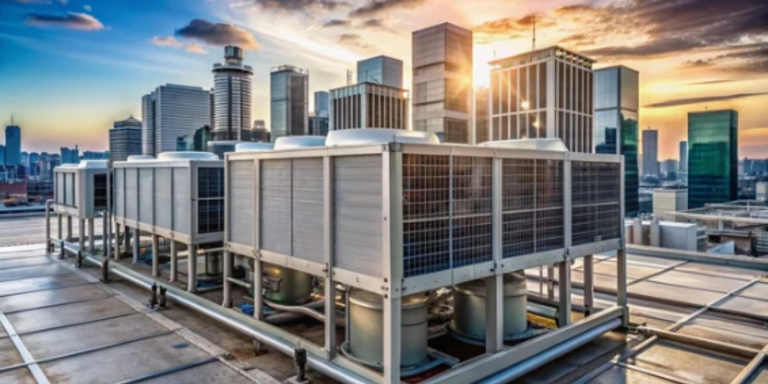
Air-cooled chillers reject heat directly to ambient air using condenser coils and fans.
Water-cooled chillers transfer heat to water, which then rejects it via a cooling tower or an air-blast cooler.
Chillers are used across commercial and industrial sectors including offices, hospitals, data centres, food and drink processing, pharmaceuticals, plastics manufacturing, and chemical processing.
COP (Coefficient of Performance) and EER (Energy Efficiency Ratio) are indicators of chiller efficiency. Higher values indicate greater efficiency for cooling output.
Air-cooled chillers offer lower installation costs, no cooling-tower requirement, reduced water consumption, and simpler maintenance. However, they can be less efficient in high temperatures, produce more noise, and require larger outdoor space.
Air-cooled chillers are usually installed outdoors or in open areas with sufficient airflow to ensure stable operation.
Water-cooled chillers typically deliver higher efficiency, longer service life, and better performance in high ambient conditions. They do, however, involve higher initial costs, more complex installation, and increased maintenance due to cooling towers or air blast systems.