
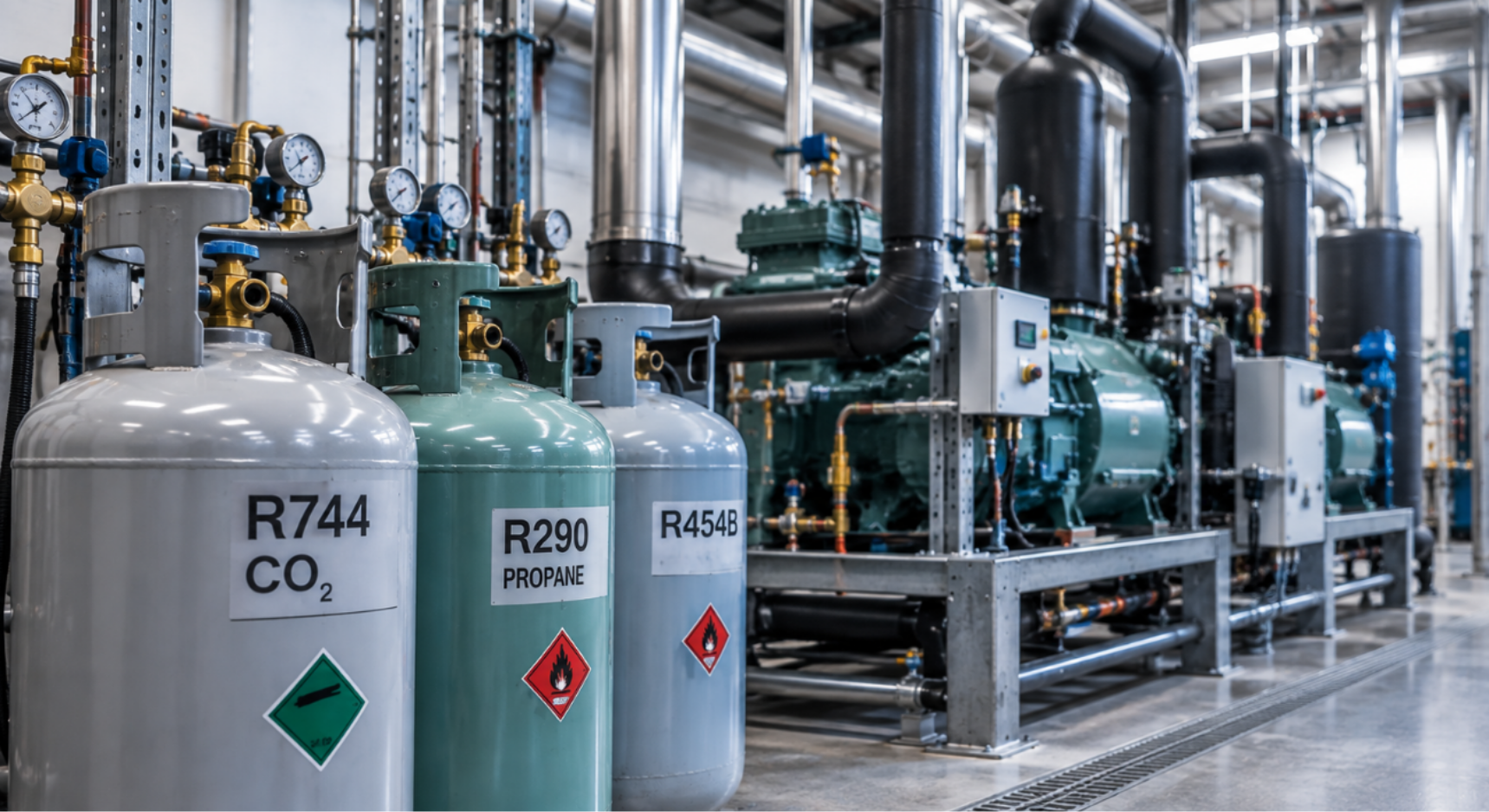
Refrigerant choice has always been an important part of refrigeration system design. But increasingly, it is a decision that needs to be considered not just in terms of what works today, but what will remain practical throughout the working life of the system.
Refrigeration equipment can remain operational for many years. During that time, regulations can change, refrigerant availability can shift and expectations around energy efficiency and environmental performance can develop significantly.
For businesses planning new refrigeration equipment, upgrades or major investment in existing systems, refrigerant choice therefore needs to form part of the long-term strategy.
Why is refrigerant choice becoming more important?
Many refrigeration systems have traditionally relied on hydrofluorocarbon (HFC) refrigerants. While HFCs do not damage the ozone layer, many have a relatively high Global Warming Potential (GWP), meaning their potential contribution to climate change if released can be considerably greater than that of carbon dioxide.
This is one reason the refrigeration industry has been moving towards refrigerants with lower GWP.
In Great Britain, the quantity of HFCs placed on the market is already being progressively reduced through the F-Gas framework. The current phase-down targets a 79% reduction by 2030 compared with the relevant historic baseline. The Government has also been considering further reform of the HFC phase-down beyond the existing schedule.
For businesses operating refrigeration equipment, this makes refrigerant strategy increasingly relevant to long-term asset planning.
Does lower GWP automatically mean a better refrigerant?
Not necessarily. Reducing GWP is an important consideration, but refrigerant selection cannot be based on one figure alone. A refrigerant needs to be appropriate for the application and the system in which it will operate.
Factors such as operating temperatures, pressures, system efficiency, capacity, equipment compatibility and safety requirements all need to be considered.
Different applications may therefore require different approaches. Lower-GWP synthetic refrigerants may be appropriate in some circumstances, while natural refrigerants such as CO₂ or ammonia may provide an alternative in others.
The objective should not simply be to select the refrigerant with the lowest possible GWP. It should be to identify a solution that balances environmental performance with safety, efficiency, reliability and the practical requirements of the site.
What does refrigerant choice mean for the lifetime of a system?
This is where long-term planning becomes particularly important. A refrigeration system specified today could still be operating well into the next decade. Looking only at current requirements can therefore provide an incomplete picture.
Businesses should consider how easily the system can be maintained throughout its expected life, whether its refrigerant is likely to remain readily available and whether future regulatory or market changes could affect servicing and operating decisions.
Great Britain already restricts the use of certain higher-GWP F-gases in specific types of new refrigeration equipment. At the same time, the wider HFC phase-down progressively limits the quantity of HFCs that can be placed on the market.
That does not mean every existing system using a higher-GWP refrigerant needs to be replaced immediately. It does mean refrigerant should be considered when businesses assess the long-term future of their refrigeration assets.
Can an existing system simply be changed to a lower-GWP refrigerant?
Sometimes an alternative refrigerant can form part of an upgrade or retrofit strategy, but refrigerant replacement should not automatically be viewed as a straightforward like-for-like change.
Compatibility with compressors, components, lubricants and controls needs to be considered, alongside operating pressures, capacity and overall system performance. Alternative refrigerants can also have different safety classifications and characteristics that affect system design and operation.
In some situations, adapting an existing system may be technically and commercially sensible. In others, continued investment in an ageing system may provide diminishing value compared with planning for replacement.
The important point is to understand the system as a whole before deciding on the appropriate route.
Should refrigerant strategy be part of wider investment planning?
Refrigeration is often critical infrastructure. Yet major decisions can still be delayed until equipment reaches the end of its life, reliability deteriorates or an urgent replacement becomes necessary. That can significantly reduce the options available.
Considering refrigerant strategy earlier allows businesses to look beyond the immediate repair or replacement decision. Future capacity requirements, energy performance, heat recovery opportunities, controls, monitoring, maintenance and refrigerant choice can all be considered together.
It can also help avoid investing heavily in a system without first considering how suitable that system will be for the years ahead.
How can businesses prepare for what comes next?
There is unlikely to be one refrigerant or system design that represents the right long-term answer for every site.
The starting point is understanding what is already installed. What refrigerant does the system use? How old is the equipment? How efficiently is it operating? What condition is it in? How critical is it to production? And are the site’s cooling requirements likely to change?
From there, businesses can begin considering their options before they become urgent. Refrigerant choice is only one part of refrigeration planning, but it can influence system design, maintenance, environmental performance and future investment decisions for years to come.
Download our white paper about understanding refrigerant market changes here.